How To Roast Almonds In Air Fryer: Quick Crispy Method
This post may contain affiliate links; recommendations are based on my real kitchen testing and honest opinion.
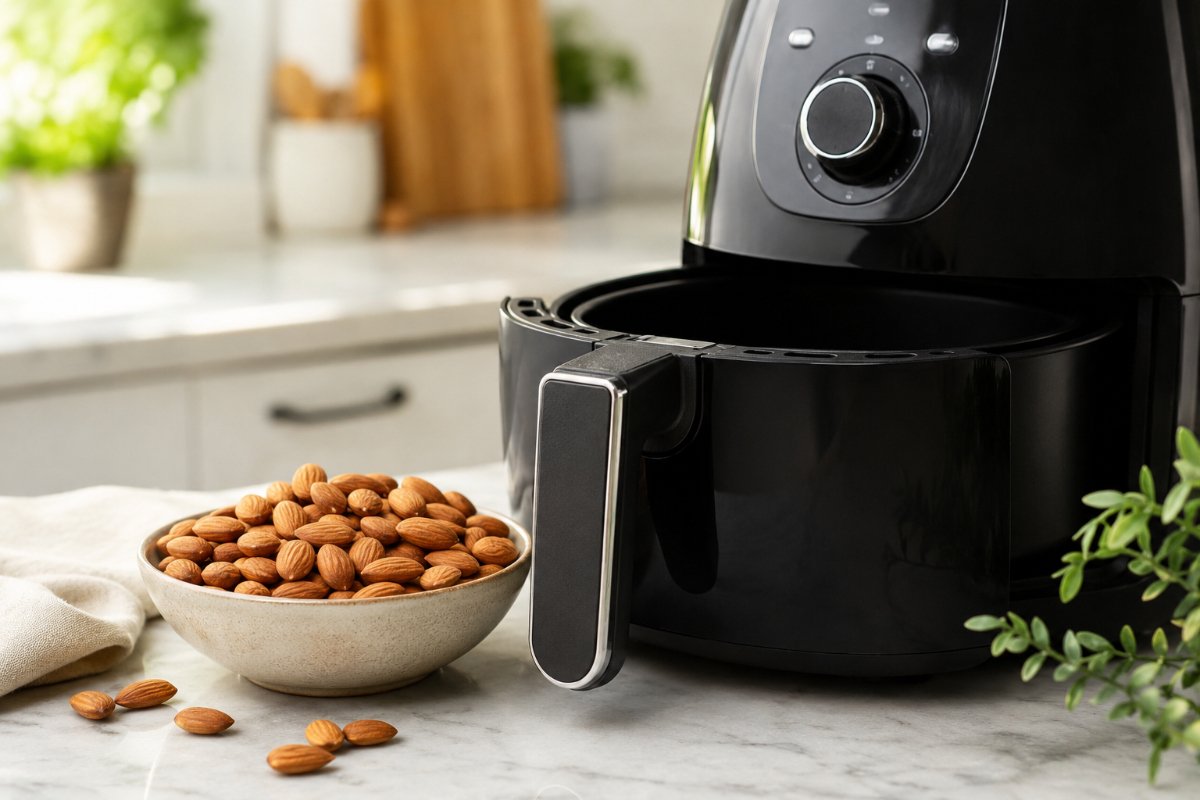
I started learning how to roast almonds in air fryer because I wanted crunchy, fresh nuts without firing up the oven for a small batch. I tried a countertop toaster oven, a skillet, and three different air fryers before settling on a method that gave even color, crisp texture, and no burnt sugar spots. Most online guides skip the little things — like how much to crowd the basket or whether to use oil — and those small misses are why people end up with unevenly roasted, bitter nuts.
If you want straightforward steps that actually work, and realistic warnings about what goes wrong, read on. I’ll show you what to buy or avoid, the step-by-step routine I now use, common mistakes I made (so you don’t), and how to fit this into weekly meal prep.
 What to Know Before You Buy (or Start)
Before you try this, a few practical things matter more than fancy presets. The right setup makes roasting almonds fast and predictable.
TABLE — Key Factors to Consider. 3 columns maximum.
Factor | Why It Matters | What to Look For
Capacity | How many almonds you can roast at once affects batch size and evenness | Basket size; 2–4 cup batches roast best for home use
Temperature control | Roasting needs steady low heat; sloppy temps burn or undercook | Precise increments, 300–350°F range
Airflow design | Even hot air avoids hot spots and uneven color | Basket with good perforation or a drawer-style with vents
Nonstick/finish | Sticky coatings or sugar need an easy-clean surface | Removable nonstick basket or washable mesh tray
Wattage & preheat | Higher wattage preheats faster but can overshoot if not timed | 1500–1800W is common; know if preheat is needed
Many marketed extras are overrated for roasting nuts. Presets for “nuts” are convenient but not necessary. A stable temperature and even airflow beat fancy timers most of the time.
Getting Set Up (or Getting Started) the Right Way
Rushing into your first roast usually means burned edges or raw centers. Take 15–20 minutes to get set up and you’ll save frustration.
Start by unboxing and wiping the basket. Run a quick wash with warm soapy water, then dry it fully. If your air fryer has a manual, skim the safety bits — most issues come from improper loading or using parchment incorrectly.
Gather a simple kit: a kitchen thermometer (optional), a small bowl for tossing, a spatula, and a timer. Preheat for 3–5 minutes if your machine needs it. Signs your setup is wrong include persistent hot spots on one side of the basket or almonds piling up and steaming instead of crisping.
This initial phase only takes a short time. Once you know your machine’s hot spots and how much 1 cup of almonds looks like in your basket, the process becomes fast.
 Step-by-Step: How to Roast Almonds in Air Fryer
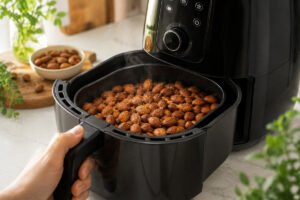
Here’s the method I now use daily. Read each step — I explain usual problems and how to fix them.
Step 1 — Pick and measure your almonds
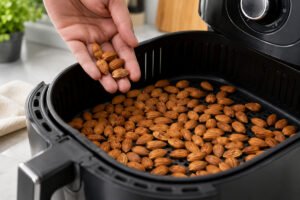
Measure by volume or weight; I use 1 to 2 cups per batch. Overfilling the basket was my first mistake — almonds need room for air to move. If you cram the basket, expect uneven roast and soft centers.
Step 2 — Decide oil or dry roast
I prefer a dry roast for plain almonds and a light oil toss for spiced versions. The common snag is using too much oil; a teaspoon for 2 cups is enough. If you want spices to stick, use a teaspoon of neutral oil, toss lightly, then add spices.
Step 3 — Preheat the air fryer briefly
Preheat 3–4 minutes at 325–330°F if your model needs it. I learned the hard way that starting in a cold basket lengthens roasting and causes more stirring. A warm basket equals faster, more even color.
Step 4 — Roast at 320–340°F and shake often
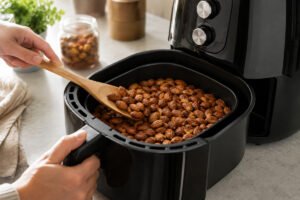
Set 8–12 minutes at 325°F for raw almonds, then shake or stir every 2–3 minutes. The usual mistake is leaving them alone until the timer ends; nuts can go from golden to bitter fast. I use a 2-minute timer on my phone to remind me.
Step 5 — Watch the color, not just the time
When almonds turn uniformly golden-brown, they’re done. Time varies by machine and nut size. I once followed a 10-minute “recipe” and burned half the batch because my air fryer runs hot. Trust the color and smell more than the clock.
Step 6 — Cool on a single layer
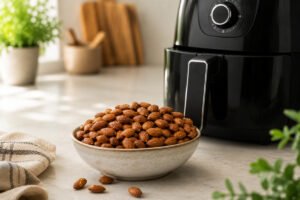
Dump almonds onto a sheet pan or plate in a single layer to cool. They crisp up as they cool. Leaving them hot and piled in the basket caused condensation and soggy nuts for me the first time.
Step 7 — Flavor and store
If adding salt, sugar, or spices, toss while warm so flavors stick. Let them cool fully before sealing in an airtight jar. A common slip is packing warm nuts into a container — that traps steam and ruins the crunch within a day.
Common Mistakes to Avoid
A short table to match common errors and how to fix them quickly.
TABLE — Mistakes and Fixes. 3 columns maximum.
Mistake | Why It Happens | How to Fix It
Overcrowding the basket | Trying to roast too much at once | Do 1–2 cup batches for even air flow
Using too high a temp | Following oven temps or presets blindly | Start at 320–330°F and adjust by color
Not shaking/stirring | Assuming hot air circulates perfectly | Shake every 2–3 minutes
Adding sugar too early | Sugar burns faster than nuts | Roast plain, then toss with sugar off heat
Sealing while warm | Traps steam, makes nuts soggy | Cool fully before storing
The single most common mistake is overcrowding. Even experienced cooks do it because it feels efficient. It persists because people underestimate how much space air needs to move.
 Signs You’re Doing It Right (or Signs of a Good vs Bad Fit)
Good signs: the almonds turn evenly golden, smell toasty-not-burnt, and crisp fully after cooling. If you can’t get even color after a couple tries, your basket might be too small or your machine may have a hot spot.
Early warning signs include burnt bits on one side, raw whites in the middle, or persistent sogginess. When you see these, reduce batch size, lower temperature, and shake more often. If fixing those doesn’t help, consider a different air fryer type or return the unit.
Ignoring early signs usually means wasted nuts and frustration. Fix small issues early — the time investment is minor but saves money and food quality.
How Often You’ll Use or Need to Maintain This
Roasting almonds is low-maintenance. Here’s how usage patterns map to care.
TABLE — Frequency Guide. 3 columns maximum.
Factor | Frequency | Notes
Small household | Weekly | Roast 1–2 cups; quick simple cleanup
Large household | 2–3x/week | Space batches or do multiple rounds
Nonstick basket | After every use | Wash so oils and sugars don’t build up
Heavy spiced use | Weekly deep clean | Soak and scrub to avoid flavor transfer
In a real kitchen routine, I roast a small batch once a week. I wipe the basket after each use and deep-wash once a week if I’ve made sweet coatings. That keeps flavor transfer low and cleanup quick.
 Options Worth Considering: How to Roast Almonds in Air Fryer
There’s no single perfect air fryer. I recommend types by budget and use.
Budget: compact basket-style air fryer. These are good for 1–2 cup batches and take little counter space. Watch for flimsy baskets that warp under heat. [Product Link]
Mid-range: larger basket or drawer-style with stable temp control. These roast more evenly and handle 2–4 cup batches. They often have removable racks that help single-layer spreads. [Product Link]
Premium: high-wattage, well-designed airflow with durable nonstick baskets and accessories. The extra cost helps if you roast large batches or want oven-like consistency. It’s worth it for frequent users but not necessary for occasional batches. [Product Link]
Spending more helps if you roast often or do larger batches. For casual use, a solid budget or mid-range unit is usually enough.
When to Return It, Replace It, or Call It Quits
If your air fryer never holds steady temps, repeatedly burns on one side despite correct loading and shaking, or the basket coating flakes off, return or replace it. Safety signs include strange smells, smoke beyond normal roasting, or electrical issues.
When contacting a seller, describe the exact symptom (e.g., “tops brown in 3 minutes while bottoms stay pale after three tries at 320°F with a single cup of almonds”) so they can reproduce and authorize a return.
Building It Into Your Kitchen Routine
Make this a small habit: roast a cup while you prep veggies or make lunch. I pair roasting with a weekly snack prep session. After the nuts cool, I portion them into small jars for grab-and-go snacks.
If you skip a week and the basket needs a deeper clean, it’s fine. A quick wash or a 10-minute soak resets it. Don’t stress about missed weeks — the method is forgiving and fits easily into a cleanup routine.
Real Kitchen Experience — What It’s Actually Like
In practice, roasting almonds in an air fryer takes about 15 minutes including prep and cooldown. The first few tries felt fiddly — I burned the first batch, under-seasoned the second, and finally got it right on the third. That learning curve took about three sessions.
Small annoyances: some baskets trap tiny bits of spice that require scrubbing. Also, your air fryer may smell faintly like the last recipe for a day or two; a lemon wipe-down helps but isn’t perfect. The surprising bit: a single change — shaking every 2 minutes — transformed my results more than swapping machines did.
After about a month of weekly use, this became a lean, reliable part of snack prep. It’s a DIY task that stays that way; I never needed professional help.
Cost Breakdown — What This Actually Runs You
Basic costs are low. Here’s a simple estimate.
TABLE — Cost Estimate. 3 columns maximum.
Item | One-Time or Ongoing | Estimated Cost Range
Air fryer (budget) | One-time | $40–$80
Air fryer (mid-range) | One-time | $80–$180
Raw almonds | Ongoing | $6–$12 per pound
Oil & spices | Ongoing | $0.10–$0.50 per batch
Premium alternative | One-time | $200+
A budget air fryer is often good enough. Spending more helps if you roast often or need larger batches. For most home cooks, mid-range is the sweet spot.
Quick Reference Summary
Fast-scan recap for easy use.
TABLE — Quick Reference. 3 columns maximum.
Topic | Key Point | Watch Out For
Before You Buy | Get a basket that fits 1–2 cups | Tiny baskets or tiny vents
First Use | Prewash and preheat 3–4 min | Start cold and expect longer times
Frequency | Weekly for small households | Deep clean if spiced often
Best Options | Budget for occasional; mid-range for regular | Premium only if roasting large batches
Warning Signs | Uneven color, burnt edges | Overcrowding or hot spot
When to Replace | Flaking coating, electrical smell | Document problem clearly for return
Final Tips — How to Roast Almonds in Air Fryer
The single most important thing is space: don’t overcrowd the basket. Air needs to flow to make nuts crisp and even. People who get consistent results treat almonds like a small batch project and shake often.
Realistic expectations: you’ll likely burn or undercook a batch the first time or two. That’s normal. After 2–3 tries you’ll have timing for your specific machine. Keep the method simple: low temp, short time, frequent stirring, cool fully, and you’ll be rewarded with reliably crunchy roasted almonds — without heating the whole kitchen.